

Alzheimer’s is a disease that many people know of, however, fail to recognize the effect the disease has on the person and loved ones of said person. Forgetting what one was going to say, misplacing the keys when in a rush, or forgetting a person’s name is highly troublesome and something that almost everyone has been a victim of at one point or another. Even though incidents such as the ones mentioned above are bothersome, they do not necessarily have a strong impact on everyday life. Alzheimer’s is a serious disease that should not be taken lightly and has a major impact on the patient and everyone involved with the patient.
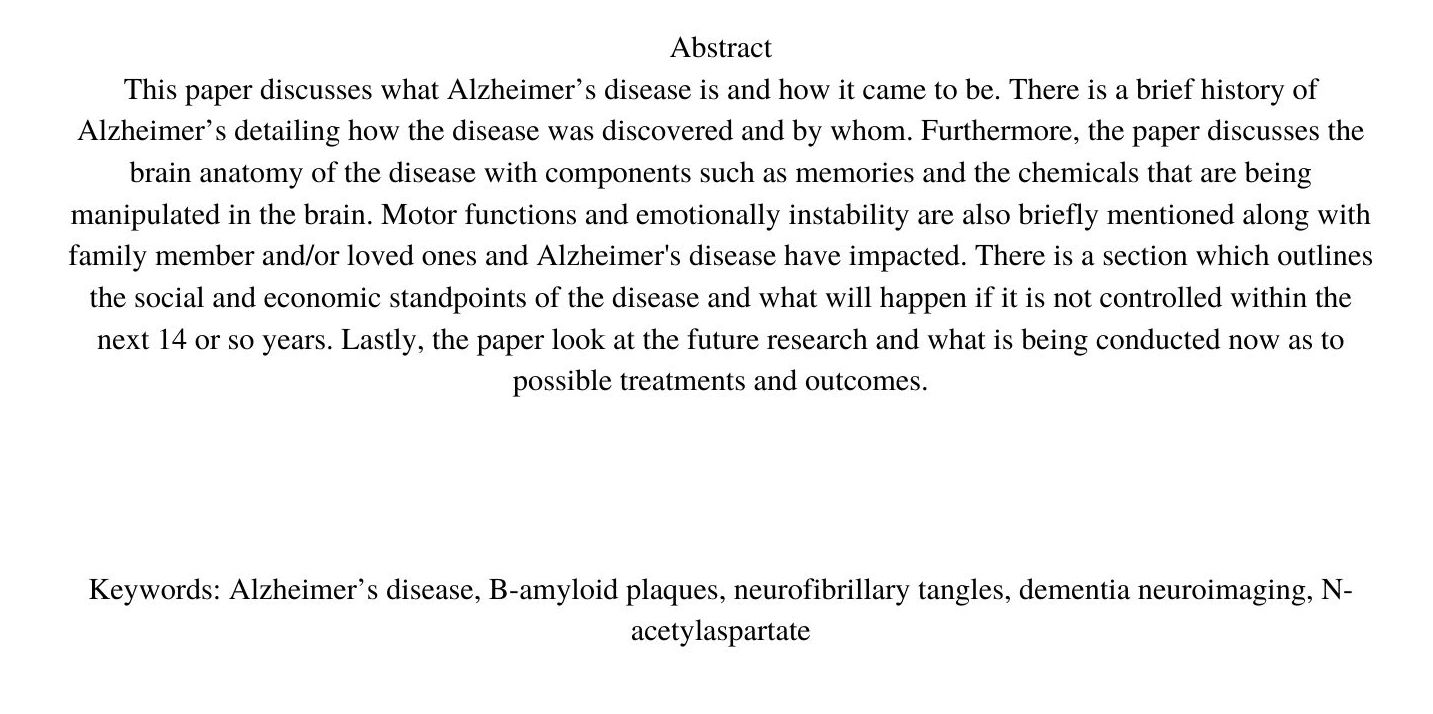
Alzheimer’s is a progressive disease in which patients may experience, “complete loss of memory, inability to function mentally, physically and socially, and loss of any awareness and involvement in the surroundings” (Davey, 2013, pg. 279). Alzheimer’s is a complex disease that effects many areas of an individual’s life. The main focuses of this paper will be the history of Alzheimer’s along with what certain activity the brain undergoes that effects the person such as: motor functions, memories, the chemicals, etc. Furthermore, the paper will also discuss the loved ones that are affected by this disease and the social and economic aspects of this disease. Additionally, the paper will also take a look at the medicine that one can take to regulate this disease along with future research that one day, may abolish the disease.
History of Alzheimer’s
Alzheimer’s has recently become an epidemic, although, it was not like this a century ago. To give some background, Alois Alzheimer was a German doctor in which the name for the disease derived from. At the beginning of the 20th century, Alzheimer was the attending physician at the mental hospital which had the very first case of Alzheimer’s disease. Auguste Deter, the first patient on record to have this disease, experienced symptoms such as hallucinations, paranoia, and confusion (Gorton (Director) & Boak (Producer), 2010). She was not able to recall her full name even when someone recited it for her just moments before. She was slowly decaying and the doctors did not understand what was happening. Alzheimer had an idea that stated that the disease was much more than an emotional problem; he was looking for evidence that supported his idea that was unheard of at the time.
To further explain this concept, Alzheimer was “trying to look for a physical complication in the brain to explain a mental disorder” (Gorton (Director) & Boak (Producer), 2010). Around that time in history, it was thought that psychiatric disorders revolved around the electricity and magnetism of the brain and “mysterious fluids that allow us to have consciousness” (Gorton (Director) & Boak (Producer), 2010). Any other way to explain a mental illness was absurd and overlooked. The way Alzheimer found evidence to support his theory was by using a staining technique in which he made slides of cells from inside Auguste’s brain. Alzheimer found large deposits of “starchy deposits and twisted fibrils” which confirmed his hunch. For the first time in history, this was evidence of a physical cause for what appeared to be a mental illness. The unfamiliar disorder came to be known as Alzheimer’s disease.
Brain Activity
Brain Anatomy and Chemicals
The brain is a confusing and complex organ of the body. It controls our most basic functions such as breathing and reflexes, but also components of us that are important to our personality such as memories and emotion. The disease begins with the loss of an individual’s memory (Gorton (Director) & Boak (Producer), 2010).
The brain is a neural network and works like a machine. It needs to be “maintained by chemical and electrical signals, and new thoughts and memories are the results of information traveling between synapses as they form, dissolve, and form again. Alzheimer’s disease occurs when this system is interrupted” (Gorton (Director) & Boak (Producer), 2010). The first pathway in the brain that is attacked is the part of the brain called the hippocampus. From this research, it can be explained as B-amyloid plaques that are referred to as AB plaques “develop in the hippocampus, the area of the brain that encodes memory, and in the cerebral cortex, the area used for thinking and decision-making”, which form between the nerve cells and block communication (Davey, 2013, pg. 280). However, what is particularly interesting about amyloid is that it occurs naturally in the body in a variety of cells. However, in the brain it undergoes a toxic form which eliminates nerve cells and erases memory (Gorton (Director), & Boak (Producer), 2010). The neurofibrillary tangles (NFTs) develop quickly as well and start to choke the nerve cells from inside. This process results in neurons no longer being able to communicate with one another and synapses begin to disappear (Gorton (Director) & Boak (Producer), 2010).
The process impacts the brain because the loss of synapses results in memories being lost and the hippocampus is slowly being destroyed; new memories are almost impossible to form and forgetting begins. Familiar places become foreign and very gradually, names and words become harder to recollect. AB plaques and NFTs continue to spread which causes neurons to die and the brain ultimately begins to shrink. Once the amyloid plaque and neurofibrillary tangles continue to progress, everyday tasks become impossible to manage. For most people, the middle stages of Alzheimer’s disease emerge once the person has been “diagnosed for several years and at this point in time, millions of synapses has dissolved away” (Gorton (Director) & Boak (Producer), 2010).
To continue with brain deterioration, the areas of the brain that control emotion are struck hard and personality may begin to change as well. Personality traits such as anger, paranoia, and fear can manifest due to the chemicals that are not keeping the brain in homeostasis. Once the entire brain is taken over, “long term memory disappear, loved ones turn into strangers, and speech fades into silence. Finally, parts of the brain that control our most basic functions such as swallowing and breathing begin to shut down” (Gorton (Director) & Boak (Producer), 2010). The brain is a complicated series of processes that when disturbed, can cause a massive amount of damage. Alzheimer’s disease is just one example of how the brain’s function can be compromised when everything is not working the way it should be.
Memories and Emotions
Memory and experiences make up a great deal of who people are: personalities, the way they react to situations, and controls emotions. When that memory or sense of who an individual is gets ripped away by this disease, it makes one question if they are even the same person. If memories make up who people are, what happens when they can no longer remember?
To go more into depth about memories and emotions, the part of the brain that controls emotion comes from the amygdala. The amygdala is more intuitive than the thinking part of the brain which is called the cortex. The cortex keeps the amygdala regulated, more specifically, the frontal lobe (Lunde, 2013). A person that is diagnosed with Alzheimer’s will experience these types of emotions however, they will have a lower ability to regulate them. Lunde discusses the emotional memory affects of people diagnosed with Alzheimer’s. When describing how people with this disease act, Lunde (2013) writes, “… they’re often labeled as having irrational and inappropriate behavior.” The whole essence of who a person is, is getting stripped away due to this terrible disease and the person they once were slowly disappears.
Memory loss is a large part of the Alzheimer’s disease and is exceedingly serious. As stated before, one loses their motor functions and ability to logically think and they lose their reasoning. However, is there any thought as to what happens to the patient’s sense of self? The Forgetting: A Portrait of Alzheimer’s (2010) outlines what it is like for a person to lose who they are. The video states, “It is scary to think about how you lived your whole life, accumulating all these memories and value system displaced in their family every single day, and the disease rips out those connections and tears the seams that actually define who they are as a person… it robs you of who you are”. When one loses their memory, the question then becomes: are they still the same person?
This question arises because memories and experiences have a large part in shaping who someone is. Lunde writes about an Dr. Sabat’s work, a member of Georgetown University’s Psychology Department and the author of, “The Experience of Alzheimer’s Disease: Life through a Tangled Veil Dementia” (2001) and, “Mind, Meaning, and the Person” (2005), that people with Alzheimer’s can create new associations-memories. These memories are related to how they are treated or through an experience one underwent. The element that is interesting is that at a later date, the patient may exhibit the associated emotion, however, they cannot consciously remember the incident or event that that said emotion is related to (Lunde, 2013).
Memories make up a majority of personality and emotions and behaviors are the way in which people react to events or situations. Alzheimer’s disease takes that away and untangles all their thoughts and memories. It is described as a treadmill one can never get off and is also one of the most basic human fears— the loss of memory and the loss of self (Gorton (Director) & Boak (Producer), 2010). Even though the patient or person diagnosed with Alzheimer’s is in misery, with a disease like this one, they are not the only ones who are suffering.
Family Members and Loved Ones
To most, family is one of the most important aspects of a person’s life; when someone has Alzheimer’s their family members or loved ones are usually the people that end up taking care of said patient. Gorton (Director) and Boak (Producer) (2010), filmed a documentary on Alzheimer’s and they stated that family members actually suffer a little more than the diseased person themselves. Their claim was supported by the fact that even though the person is losing all sense of who they are, they have no recollection of this tragic event. The family members or loved ones have to watch this decline and deterioration in someone whom they love.
As the patient continues down this path of memory loss, both physical and mentally, the people around them are effected but in a different way. It is said that the families and caregivers experience depression from having to see these events occur while the patient feels trapped and helpless. Alzheimer’s disease is torture to anyone involved and the family dynamic is changed (Gorton (Director) & Boak (Producer), 2010).
The family members and loved ones are usually the people that are caring for the person with Alzheimer’s (if they are not put in a facility). However, even they become strangers after some time. The disease starts by an individual not recognizing a place or forgetting where they are. Eventually, the loved ones become strangers and the person reverts back to childlike behaviors. That emotional instability also causes the caregiver emotional instability because he/she is witnessing their family member or person of great importance to them, losing a sense of who they are (Gorton (Director) & Boak (Producer), 2010).
Social and Economic Standpoints
Alzheimer’s can be catastrophic to anyone who obtains it and not only does it effect one’s family, the problem is much greater than that; it is a social and economic tragedy as well. Many people do not believe that Alzheimer’s can influence society and the economy, however, they are greatly mistaken. This disease does not only impact the victims of such a disease (and their loved ones), but moreover, an entire population.
Alzheimer’s usually occurs in an older age, around 65 years. Every year a person passes the age of 65, their chances of receiving this disease increases. By the time an individual hits the age of 75 years old, they have another 10 percent increase. Finally, if a one sees 85 years of age, their chances are much greater. The number can range from 25 percent to 47 percent of people past the age of 85 having some sort of dementia (Gorton (Director) & Boak (Producer), 2010). More and more people are living longer life spans which is beneficial for certain aspects of life such as seeing grandchildren and great grandchildren, however, that does not stop the disease. About 20 years ago there was approximately 500 thousand people diagnosed with this disease. To this day, the number substantially increased to about 5 million (Gorton (Director) & Boak (Producer), 2010).
If looked at from an economic standpoint, once the baby boomers acquire this disease, that number of people diagnosed with Alzheimers is going to increase rapidly. More than likely, a majority of the federal budget will be consumed by caring for Alzheimer’s patients by the year 2030 if nothing is done. There is an estimated total economic cost of people “losing their jobs, having to give them up to take care of a loved one, and medical bills at about 100 billion dollars already, annually” (Gorton (Director) & Boak (Producer), 2010). However, if the disease can be slowed down about 5 years, it will decrease the number of people who would have this disease 40 years later by 50 percent. This is due to the fact that Alzheimer’s does not start until an individual hits a late age. On the other hand, if it is delayed by 10 years, the disease will practically be abolished. This is because a vast majority of people who obtain this disease get it within 10 years of the end of their life from other causes.
Future Research
Alzheimer’s is one of the diseases that no cure exists for it— yet. Scientist and researchers are avidly continuing their investigations and trying to find a cure for this awful disease. However, there are medications in which one can take to regulate it, however, it only slows the progression down. Researchers are actively looking for ways to abolish the disease all together and find a universal cure.
Wimo (2015), writes about what can be done when trying to find cures and medications concerning this disease. He states:
We need to use a palette of designs, such as traditional, and pragmatic, randomized, controlled trials, open-label follow-ups, and use of register and observational data and simulations and modeling to get a comprehensive overview. Patents for existing symptomatic drugs for Alzheimer’s disease have expired now, making them very cheap. Potential disease-modifying treatments are (although severe failures have occurred) in the pipeline, and the role of choline esterase inhibitors and memanxine in future studies of resource and use and cost-effectiveness will be compared with disease-bodying treatments (Wimo, 2015).
This means that instead of looking at this disease at one way, and trying only one solution at a time, they are trying to look at Alzheimer’s as a dynamic disease in which can be inspected at from all different kinds of angles.
Hamilton (2015), discusses the previous efforts that have tried to treat Alzheimer’s. He stated that in the past, only a single target was focused on which was beta-amyloid. This approach would have to be a compound of a molecule that could get in the brain with ease, which is something that has never been done before. Also, after attacking the plaque, the molecule would have to exit the brain immediately for it to be safe to be used on living patients (Gorton (Director) & Boak (Producer), 2010).
Looking at this form a new prospective, Marcia Taylor, Alzheimer’s Association International Conference company director of biological research, has come up with a new idea. She stated that her goal was to design a pill that can be taken once a day that could either stop Alzheimer’s altogether or at least slow it down. This would be accomplished by making a drug that would prevent the build up of the two toxic proteins (Hamilton, 2015).
Taking a step back from traditional pharmaceutical approaches, another avenue that can be perused is physical activity. Erickson, Weinstein, and Lopez (2012), looked at Alzheimer’s in a different way. They suggested that physical activity is one way that can reduce the risk for Alzheimer’s.
From their studies, they concluded that, “Neuroimaging studies suggest that physical activity may reduce the risk for cognitive impairment by increasing the size of brain areas involved in memory formation, increasing functional brain activity in frontal and hipppcagpal brain regions and by offsetting the genetic and molecular risk factors associated with AD such as elevated levels of AB and lower levels of NAA (N-acetylaspartate) (Erickson, Weinstein, Lopez, 2012). This research provides compelling arguments that state physical activity can reduce the risks of Alzheimer’s in the future. It does this by improving brain health throughout the lifespan, especially in late life when the risk for cognitive impairment is at its highest. However, the brain retains its natural capacity for plasticity well into late adulthood and by participating in physical activity, may take advantage of this characteristic about the brain. Another thing that was discovered is that even a moderate amount of physical activity can improve brain health and increases the size of brain function in different areas (Erickson, Weinstein, Lopez, 2012). Even though there are a lot of studies that are being conducted about Alzheimer’s disease, there still remains a great deal of unanswered questions.
Conclusion
Alzheimer’s is a serious and deadly disease. It strips one’s personality, memory, motor functions, and the whole essence of a person right from under them. It is a physical problem in the brain that effects the emotional stability of a person. Years ago, that idea was unheard and unthought of, however, the disease made its mark and is becoming an epidemic. Alzheimer’s can cause obvious memory loss, a change in personality, can cause an individual to be irritable and confused, but it does not only effect the patient. Loved ones and family members are also victims of such a disease. A fair amount of caregivers are diagnosed with depressed from having to see a person in which they love and care for, deteriorate right in front of their eyes. Alzheimer’s disease is also a social and economic problem if it reaches its maximum height with the baby boomers. There are treatment plans and research being conducted to either slow down the progression or stop it completely. Even with all of this progress, there are still a great amount of unanswered questions.
Davey, D. A. (2013). Alzheimer’s disease, dementia, mild cognitive impairment and the menopause: A ‘window of opportunity’?. Women's Health, 9(3), 279-290. doi:10.2217/whe.13.22
Erickson, K. I., Weinstein, A. M., & Lopez, O. L. (2012). Physical activity, brain plasticity, and Alzheimer's disease. Archives of medial research, 43(8), 615-621. doi:10.1016/j.arcmed. 2012.09.008
Gorton (Director), D., & Boak (Producer), N. (2010, October 18). The forgetting | pbs [Video file]. Retrieved from http://www.pbs.org/theforgetting/
Hamilton, J. (Producer). (2015, June 19). Alzheimer's drugs in the works might treat other diseases, too [Television broadcast]. MI: NPR.
Lunde, A. (2013, September 4). Emotional memory affects behavior of persons with alzheimer's- Mayo clinic [Web log post]. Retrieved from http://www.mayoclinic.org/emotional-memory/expert-blog/bgp-20055930
Wimo, A. (2015). Long-term effects of alzheimer's disease treatment. The Lancet Neurology, 14(12), 1145-1146. doi:10.1016/s1474-4422(15)00302-6
This paper examines the power and authority that individuals give people with titles. Specifically, it focuses on the title of “Coach” and the athletic community through Critical Discourse Analysis and the Social Semiotic theory, textual evidence for this phenomena are examined in order to come to the conclusion that identity is a factor in such occurrence. Cassidy, Jones, and Portac (2016), Jørgensen and Phillips (2010), and Machin and Mayr (2012) are cited to provide analysis for this paper. Different textual evidence is provided such as press conferences varying in sport as well as different coaches and a film are all analyzed. The purpose of critical discourse analysis is to provoke social change, therefore suggestions as to stop this social problem are also provided.
Titles seem to be very important in most professions. Titles such as “professor”, “legislature”, “Lieutenant”, “Doctor”, etc. are commonly used and the people who have obtained these titles—for the most part—wish to be addressed as such. For instance, in a collegiate classroom it is not uncommon for students to address their professor as “Professor X” for example. In a military setting, the title of “lieutenant” is commonly used to address a superior. If one goes to a hospital or an Urgent Care, usually he/she address the person diagnosing the problem as “Doctor”. However, there is one particular title that seems to get carried over to any setting. The term “coach” is one that appears to be carried over multiple different instances and used in a way that is sometimes inapplicable. Examples of this happening are seen in movies, press conferences, books, and other types of athletic texts. This paper will examine the discourse around the phenomena as to why people call coaches “Coach” in other settings than what the term is meant for and why this might occur through the application of Critical Discourse Analysis.
To start, the term coach can be defined as “someone who trains a person or team of people in a particular sport”, “a person who is in charge of a sports team” or, “someone who gives people special teaching in a particular subject, especially in order to prepare them for an examination” (Collins English Dictionary, 2018). In all contexts, the term couch is framed as a mentor or guidance for the people they are leading. Specifically, this text will only analyze “coach” in the athletic/sports environment. Considering the term can be applied to various different settings, only the discourse in the athletic context will be examined.
Historically, there are many different schools of thought when it comes to what coaches are actually supposed to do. For the most obvious reason, they are intended to work with the athletes and enhance their overall performance by teaching different plays, sharing experience and knowledge, and through practice. Cassidy, Jones, and Potrac (2016) points out that in the past “coaches viewed as mere technicians involved in its transfer. The discourse has been one related to ‘processing’ and ‘packaging’ athletes in attempts to attain ever higher levels of ‘output’” (p. 10). The authors site Bale and Sang 1996 to come to the conclusion that because of this language and coaches being viewed in this discourse, athletes are looked as less than humans and more like objects. This reinforces that power dynamic that is already established between the coach-athlete relationship.
Due to that presence of power and authority, it is one possible explanation as to why athletes call their coaches “Coach” outside of the coach-athlete relationship which is the discursive representation. Machin and Mayr (2012) describe discourse as “a term that has been used to describe the broader ideas shared by people in a society about how the world works. Discourses are comprised of ideas, values, identities, and sequences of activity” (p. 11). In this sense, the discourse is how people think of coaches and address them as “Coach” even if they never have been trained by said person. To give another definition of discourse that is applicable to this occurrence, Jørgensen and Phillips (2010) give five common features of discourse. The second feature, which is important to this subject, states:
discourse if a form of social practice which both constitutes the social world and is constituted by other social practices. As social practice, discourse is in a dialectical relationship with other social dimensions. It does not just contribute to the shaping and reshaping of social structures but also reflects them (p. 61).
As the population continues to use the term “coach” very commonly, the authority is reinforced through this relationship. The more that it happens, the more power is given to the coach than what is required originally. Jørgensen and Phillips (2010), also states that discourse—especially in this sense—is a form of action where individuals shape the world while simultaneously being “a form of action which is socially and historically situated and in a dialectal relationship with other aspects of the social (p. 62)” at the same time. Along with this discursive representation, there is also a semiotic dimension present as well. Semiotics looks at signs and signifié dealing with meaning, form, and content. Along with this discursive representation, there is also a semiotic dimension present as well. Semiotics looks at signs and signifié dealing with meaning, form, and content. “In a Social Semiotic approach we are concerned with the underlying available repertoire of signs and their use in context to communicate wider ideas, moods and attitudes and identities, and we are interested in why specific means were used to create these” (Machin and Mayr, 2012, p. 19). This correlates with the idea that it is important to look at the different terms used to describe certain individuals. The books gives examples of women being described as “wives” or “mothers” and connecting that with the processes they perform. One can take the idea, of “coach”, and then look at how it is used to describe a person who trains athletes (for this paper specifically), leads their players, and teaches. From this, one may ask, “Why are others (non-athletes of that specific coach) calling that person Coach, if this specific coach does not exorcize power over the individual?”
This is a social problem because people who practice this gives the person with the title of “coach” authority and power in a place, or to people, that they might not necessarily have power over. By doing this, it is a misrepresentation of the amount of authority said coach may have. Although, avoiding the issue of essentialism, there are instances where this does not happen. Examples include in the media where they do not always refer to the coach as “Coach __”, some athletes just call their coach or other coaches by their last name omitting the word “coach” in general, and there are instances where coaches just use the full or last name when referring to other coaches. However, this is not to say that this phenomena does not occur frequently nor is it not apparent in the media. Through the methods of Critical Discourse Analysis and the Social Semiotic approach—which differs from traditional semiotic approaches in a variety of ways—this paper will try to answer the question above by means of examining press conferences from different coaches as well as a film text.
To look at the profession of coaching more specifically and why that term carries power and authority with it, Cassidy, Jones, and Potrac (2016), relates coaching to teaching. It is stated that if coaches and the general population thought of coaching as teaching, which provides a strong idea of the coach “educating the whole person, since teachers are expected to develop the cognitive, affective, and psychomotor domains of the children or people with whom they work” (p. 32). Thinking of coaching in this aspect gives power to that person that is more than structuring plays, teaching a sport, or sharing their expertise on that sport, but rather an all encompassing view of coaches that they have more responsibility than that. A strong focus is on the psychomotor aspect while little recognition is on the affective, the text urges coaches to teach more holistically which again, gives them more power over the athletes or the individuals they are training. The power they obtain doing this then is seen throughout a community which in turn allows them to have the title of “Coach __”. This reinforces Jørgensen and Phillips second feature of Critical Discourse Analysis of the dialectical relationship. People are changing the world by also being changed by the world.
Considering the understanding of the discursive meaning as well as applying the Social Semiotic approach to this circumstance, the textual evidence for this occurrence can be examined. Firstly, the movie Friday Night Lights (Berg, 2004) will be examined. This text is significant because it is a move that follows not only the athletes, but also the coach, who plays a vital role in this movie. The coach in this film, Gary Gaines, who at first struggles with gaining respect from his players, eventually becomes a very influential person in the players’ lives. An example of non-athletes using the title “coach” would be at 00:01:54 when a radio host is talking on the air. When referring to the coach’s salary he stated, “…there’s a lot of talk that Coach Gaines, with that $60,000 a year salary…” (Berg, 2004). Then again at 00:02:20 the person who the radio host is speaking to, Jerry, states “I’m telling you right now, Coach Gary Gaines, they could give him $100,000 a year…” (Berg 2004). Another example is when Gaines is at a dinner party, speaking with a woman. She asks, “…where’s the beef Coach?”, referring to the height and size of the players on his team (Berg, 2004, 00:14:59).
These are just a few examples of this phenomena that is found within the first few minutes of this film. To provide context to this film, football is very important to the majority of the people in their town. Therefore, Gaines is looked at highly throughout most of the movie. Machin and Mayr, when discussing power, discourse, and semiotics state “A choice of word of visual element might suggest kinds of identities, values, and activities” (2012, p. 29). Due to the various people referring to him as “Coach” and choosing to use that language, it reinforces the idea that in some way, he has authority and that his identity of “coach” is always present even when he is off of the field.
A more recent example of this would be Ohio State’s football coach, Ubran Meyer, who is retiring and Ryan Day who is preparing to be the incoming coach. It is very interesting when examining the press conference transcript, because there are a few instances where Urban Meyer is referred to as “Coach Meyer”, and Ryan Day is just “Day, as well as referring to other coaches by “Coach___” as well. A reporter asked, “When did it become clear to you that it was time to step down? And are you at peace with it? Unlike some other exits, is this it, truly it, for your football career?” (Meyer, 2018, para. 28). In response, Meyer stated:
…my witness of the work Ryan has done and made this decision, not as difficult as I thought, because I know the infrastructure, like Gene talked about, is going to be secure with Coach Marotti and the rest of the staff. I think it’s very healthy. We recruited very well (para 30).
This is an example of referring to the incoming, or new (new in the sense as new to the team, not a newer coach), coach by just the last name but then referring to a different coach as “Coach Marotti”.
Further, Ryan Day answered a question which included the phrase “to be taking over for Coach Meyer…” (Meyer, 2018, para. 51). This is interesting considering up until now, Meyer only referred to his successor as either Ryan or Day, never “Coach Day” and again in paragraph 95 when Day states “I think Coach Meyer and I’s values…” (Meyer, 2018). Lastly, the media in paragraph 107, refers to Meyer as only “Coach”, which is the only time that this has occurred. The question reads, “Coach, you say you want to hang around here, Urban…”. As the reporter had to clarify which coach he/she was speaking to, leading with the title of “Coach” in reference to Meyer reinforces the authority and power dynamic. Throughout this transcript of the press conference, when giving quotes the names are listed as “Coach Meyer” or “Coach Day”, although, after reading the headline stating that they are both coaches, it raises the question of, is that title of “Coach” necessary in an event like this, when even the media—for the most part—called these individuals by their first name for a majority of the time?
Although, that seems to be the norm when looking at press conferences. In Jim Harbaugh’s press conference transcript, whenever he is talking it always “Coach Harbaugh” rather than the full name or omitting coach completely. Harbaugh (2015) also calls Bo Schembechler “Coach Schembechler”. In this context, Harbaugh is discussing how he is going to run to the program and states that he would like to run it the same way Schembechler did. “Not a day goes by really where I don’t think about Coach Schembechler…” (para. 10). Furthermore, in paragraph 20, he refers to another coach in the same manner. “And starting with Coach Baxter, feel very confident that we will” (Harbaugh, 2015). Lastly, in responding to the media’s question about Harbaugh’s experience, he states, “And it’s so close to your family that I had a chance to spend the evening with Coach last night as his restaurant” (para. 22). In this sense, Harbaugh does not even bother putting the name of the coach.
In the press conference transcript about Michigan State about the Paul Bunyan Trophy, their head coach of football Mark Dantonio is being interviewed. In paragraph 14, Dantonio states, “I think Mike Tressel talked to Coach Narduzzi a little bit…” (Dantonio, 2018). He even mentions the former coach of Michigan State as “Coach Saban” in paragraph 17 when discussing the importance of coaching. Lastly, in paragraph 41 he calls his opponent, “Coach Harbaugh” stated “does a great job. I think he’s all about that” (Dantonio, 2018). In these examples and the ones mentioned above, it seems that when someone refers to a coach as “Coach__”, it is almost a sign of respect. Even though that person is not being directly coached by whom they are calling “Coach”, it seems to be used as commonly as “Mr.”, “Mrs.” and to be a polite gesture. This leads into the question of identity. Titles such as “Mr.” are viewed as polite as well, although that does not seem to fit in this setting because coaches are referring to one another’s profession, and their identity of being a coach.
Cassidy, Jones, and Potrac (2016) offer an explanation as to why this phenomena may occur. They state:
In delving deeper into its nature, we see that the discursive perspective is interested in the complex ways in which speakers contrast and understand conversation, with all utterances being treated as ‘meaningful social doings’. Language is therefore considering not only as a tool for communication or description, but as a ‘social practice… a way of doing things’. It is viewed as a ‘domain in which our knowledge of the world is actively shaped’ as it provides the means that allow us to make sense of our own identities and circumstances (p. 116).
The term “coach” in every situation listed above, is used a tool for communication description. However, considering that other coaches call one another “Coach”, the media does it, and other non-athletes, it is then a social practice that shapes our society. The coach’s identities at this point is to just be coach, which in this context is understandable and makes sense due to the questions and topics their press conferences were on. Although, the way the transcript was written and how the media mentions the coaches, gives them no other identity.
To contrast these press conference transcripts, there are others in which the same phenomena is still occurring, but the writing and layout are different. Oakland University’s basketball coaches Greg Kampe (men) and Beckie Francis (women) are being interviewed about the upcoming championship, as well as a few selected players. The way that this press conference is set up is that instead of the format from the examples above such as “Coach Kampe:”, “Media:”, the bolded words read, “On the leadership of the team”, “On OU’s depth versus other teams in the league”, “On the seed that the tournament champion will get it”, etc. Examples of non-athletes referring to Kampe as “Coach Kampe” is in paragraph 36 where Francis states, “When you asked Coach Kampe that question, I had a warm feeling all over…” (Kampe, 2009). In this instance she easily could have said “Mr. Kampe,”, “Kampe”, or even Greg. Another instance where this occurs is when senior Jessica Pike of the women’s basketball team states, “I heard Coach Kampe say at the men’s press conference that you can’t play the championship game unless you get to Tuesday” (Kampe, 2009, para. 41). It is clear that Kampe is not her direct coach and she was talking to the media calling him “Coach Kampe” which shows the same language occurrence.
This correlates with Machin and Mayer’s idea of representational strategies in language. “In any language there exists no neutral way to represent a person. And all choices will serve to draw attention to certain aspects of identity that will be associated with certain kinds of discourses” (2012, p. 77). The choices that Francis and Pike make when referring to Kampe is to represent him as a coach, which is explicit. However, in the context of the setting he is already being addressed by his identity of coach, so referring to him as such seems almost unnecessary.
The last example that will be looked at is from Norte Dame’s coach Willingham’s press conference regarding Louisville’s coaching position. One thing that is interesting about this press conference transcript is that it does not mention Willingham’s first name. It does have the usual set up of “Q:__”, “Coach Willingham:”, but when one is reading it there is no indication of a first name, the coach is always referred to as, “Coach Willingham”. Furthermore, Willingham mentions, on many accounts, to different coaches as “Coach” and then their name. For instance, in paragraph five, Willingham states, “The process there was that it would give Coach Baer the best opportunity to overlook the entire defense” (Willingham, 2002). In paragraph six there is mention of a “Coach McDonell” and a “Coach Diedrick”. Cassidy, Jones, and Potrac (2016) site (Ball 1990:17) when discussing the discourses of coaches and how it relates back to this idea:
Discourse, then, is essentially about power; it is about ‘who can speak where, when and with what authority’… it becomes not only about what is said and heard, but also about what is not, as what is left out in addition to what is included will influence participants views of ‘necessary’ knowledge (Penney 2000)” (p. 116-117).
As stated before, this could be looked at as examples of showing mutual respect, authority, and power. The quote above relates to this topic because what is said, as mentioned previously, are non-athletes or people who a certain coach is not directly coaching, are being called “Coach”. The thing that is being left out is the question of why this phenomena is occurring. Through these two sides, it influences the general public’s view.
One can notice that in all examples, whether it be coach referring to another coach, an athlete that is not directly being coached by the person they are referring to as “Coach”, or the media, it is clear to see the three dimensions of Critical Discourse Analysis (CDA). Fairclough has a three dimensional model for CDA which consists of a text, a discursive practice, and a social practice (Jørgensen & Phillips, 2010, p. 68). To start, the text that was examined was everything mentioned above. The film Friday Night Lights as well as the samples of the different sports press conferences from different teams. The examples varied in school and in some instances, varied in the sport, to show that this is a common theme amongst most people in the athletic community. The text is the transcript of the press conferences and the consumption is the audience that is going to read it which is the discursive practice in this sense. To be more specific, the textual analysis of the above examples looks at the vocabulary of the coaches, players, and media in referring to the different coaches.
Jørgensen and Phillips argue that text and discursive practices are different and should be analyzed in respect to their own elements. “Analysis of discursive practice genres focuses on how authors of texts draw on already existing discourses and genres to create a text, and on how receivers of text also apply available discourses and genres in the consumption and interoperation of the texts” (2012, p. 69). This paper is examining the athletic genre and the framework that authors of text acknowledge coaches as “Coach”, in which the audience consumes this discourse and employs a social practice. An important component of this model as well as the ideas of power and authority embedded in this phenomena, Fairclough argued is that power is repressive as well we productive. Even though communication is the mechanism by which power is exerted, it is still needed and that people are always exercising power over one another. When examining the three dimensional model of CDA, power needs to be a competent when referring to this text. “Hence, it is only through discursive practice—whereby people use language to produce and consume texts—that texts shape and are shaped by social practice” (Jørgensen and Phillips, 2010, p. 69).
The results of this examination is that there is a discursive component, a semiotic dimension, and a social practice all embedded in this phenomena. To explain in depth, coaches are being referred to by their title in other settings outside of being on a field/court in the athletic environment. Other coaches, the media, and people they do not directly train are calling them “Coach” with a capital C to refer to their title. However, the problem with this is that the individuals that participate in this practice are giving them unnecessary power and authority. Coaching is correlated, in some aspects, to teaching and seen as an authority figure to their players, but when people besides their players continue to use that title when referring to them it becomes a social problem.
Critical discourse analysis and Social Semiotic theory was used to examine five different press conferences as well as a popular film. Throughout these texts, multiple examples of the phenomena were analyzed. The findings revolved around ideas of authority and power as well as those of identity. When individuals give power to people who do not have power in a certain domain, it can cause societal problems. All of this into consideration, the goal and main purpose of critical discourse analysis is not only to acknowledge the social problem and analyze the text from which it comes, but also to start a social change. As Fairclough states, power exists outside of discourse. Although the relationship between these two is that even though power lies independent of discourse and is outside of discourse, it can still be altered and changed through discourse. Therefore, the primary aim of critical discourse analysis is to enact societal change through discourse.
If you like what you see and want to work together, get in touch!
akoots07@gmail.comGive me a call!